

How it works
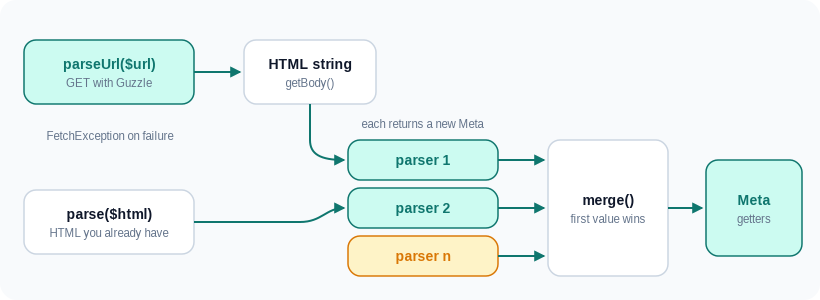
Three kinds of objects take part:
| Object | Role |
|---|---|
Scraper | Downloads the page (optional) and runs the parsers. Holds one Guzzle client and the last downloaded body. |
Parsers (ParserInterface) | Read one kind of metadata from an HTML string and return a new Meta. Stateless: one instance can parse any number of pages. |
Meta | The result: one nullable field per value, lists of Author, Section and Tag. |
Step by step
1. Getting the HTML
You either have the HTML already and call parse($html, $parsers), or you call parseUrl($url, $parsers):
parseUrl()sendsGET $urlwith the Guzzle client the scraper created in its constructor (or the one you gave it) and the request options.- Any Guzzle exception (connection error, timeout, TLS error, too many redirects, a 4xx or 5xx response with the default
http_errors) becomes aFetchExceptionwith the Guzzle exception asgetPrevious(). Nothing is parsed andgetBody()keeps the body of the previous successful call. - Otherwise the body is stored (
getBody()returns it) and passed toparse(), exactly as the server sent it: no charset conversion, no decompression beyond what Guzzle does.
2. Running the parsers
parse() creates an empty Meta and, for each parser in the order of the array, calls $parser->parse($html) and merges the returned Meta into the result. The parsers never see each other's results.
An empty parser list is allowed: you get an empty Meta (parseUrl($url, []) is a way to only download a page, then read getBody()).
3. Merging
Meta::merge() copies a value only into a field that is still empty, so the first parser that finds a value wins:
- a text field counts as empty when it is
null,''or'0'; - authors, sections and tags are copied as a whole list, from the first parser whose list is not empty; lists are never mixed;
- the published and modified times are copied when they are
null.
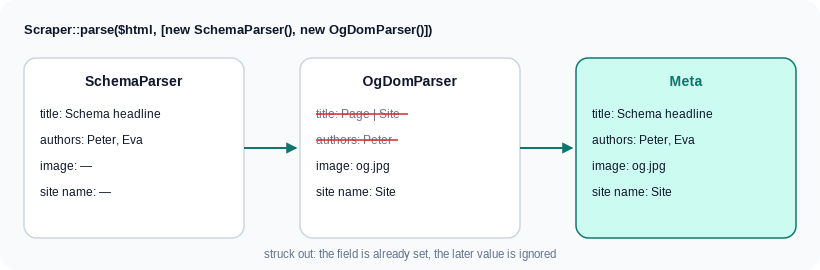
Combining parsers shows what this means for real pages.
What the parsers do not do
- Run JavaScript. Metadata that a page adds in the browser is not in the HTML the server returns.
- Resolve relative URLs. An
og:imageof/img/a.jpgis returned as/img/a.jpg; resolve it against the page URL yourself (the link preview example does). - Validate values. URLs, types and dates are returned as the page wrote them (dates keep the page's offset and must be absolute, see The Meta object).
- Throw on bad input. Malformed HTML or JSON gives the values that could be read; see Error handling.