

Layers
A request passes through a fixed set of layers. Each one has a single job and its own interface, so you replace one without touching the others. The handler, where your logic lives, sees only clean values.
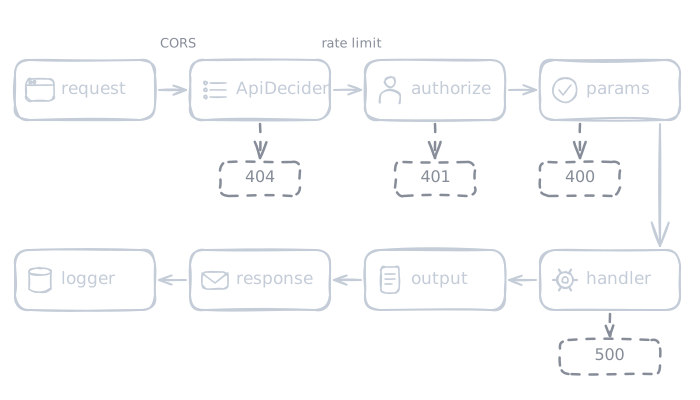
One request that passes, one without a token and one with wrong input:
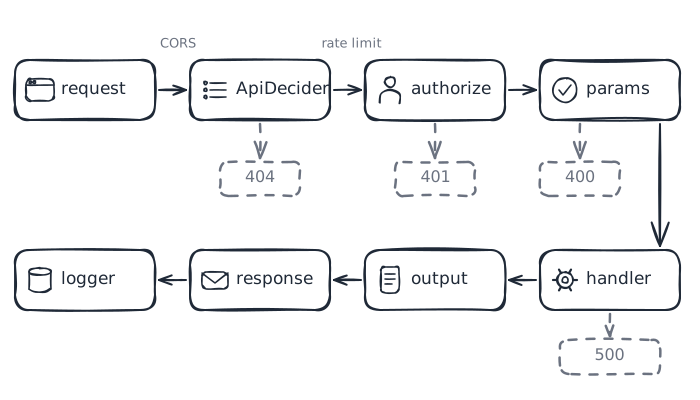
| Layer | Interface or class | Its job | Stops the request with |
|---|---|---|---|
| Route | Nette router | Turns /api/v1/users into version, package, apiAction | |
| Presenter | ApiPresenter | Runs the layers below in order | |
| CORS | setCorsHeader(), setCorsAllowedOrigins() | Adds Access-Control-* headers | |
| Endpoint lookup | ApiDecider, EndpointIdentifier | Finds the handler, authorization and rate limit | 404 |
| Rate limit | RateLimitInterface | Counts calls per client | 429 |
| Params | InputParam, ParamsProcessor | Reads and validates input; errors wait for authorization | |
| Authorization | ApiAuthorizationInterface | Decides who may call | 401 |
| Param errors | ErrorHandlerInterface::handleInputParams() | Reports invalid input | 400 |
| Handler | ApiHandlerInterface, BaseHandler | Your logic, returns a response | any code |
| Outputs | OutputInterface, ConfiguratorInterface | Checks the response against its schema | 500 |
| Errors | ErrorHandlerInterface | Turns failures into JSON | |
| Logger | ApiLoggerInterface | Records handled requests |
The exact order, with code, is on ApiPresenter pipeline.
Route
One route sends every API URL to the presenter. The placeholders become the parts of the endpoint.
$router->addRoute('/api/v<version>/<package>[/<apiAction>][/<params>]', 'Api:Api:default');GET /api/v1/users/detail gives version 1, package users and apiAction detail. See Getting started.
ApiDecider: which endpoint
ApiDecider holds the list of endpoints. Each entry connects an EndpointIdentifier with a handler, an authorization and an optional rate limit:
- addApi(Tomaj\NetteApi\EndpointIdentifier('GET', 1, 'users', 'detail'), App\Api\UserDetailHandler, @bearer, @userLimit)So who may call and how often belong to the endpoint, not to the handler. One handler can be public under one URL and protected under another. See ApiDecider and endpoints.
Rate limit: how often
RateLimitInterface::check() returns null for no limit, or a RateLimitResponse with the limit and what remains. At 0 the presenter answers 429. It runs before authorization, so a client guessing tokens is limited too. See Rate limiting and the rate limit example.
Authorization: who
ApiAuthorizationInterface has two methods:
public function authorized(): bool;
public function getErrorMessage(): ?string;
false answers 401 with the message. Built in are NoAuthorization, BearerTokenAuthorization, header, query and cookie API keys, and BasicAuthentication. Write your own for roles or sessions, as in the custom authorization example. See Authorization.
Params: what came in
params() of the handler lists the inputs. Each param knows where to read (query, POST, PUT, cookie, file, raw or JSON body), whether it is required, its type and allowed values:
public function params(): array
{
    return [
        (new GetInputParam('page', InputType::INTEGER))->setDefault(1),
        (new JsonInputParam('order', file_get_contents(__DIR__ . '/schema/order.json')))->setRequired(),
    ];
}
The presenter reads them all, then reports errors as 400 with a message per param. The handler never sees invalid input. See Input params.
Handler: your logic
The handler gets $params with the clean values and returns a response. It does not check tokens or parse the request.
public function handle(array $params): ResponseInterface
{
    $user = $this->users->find($params['id']);
    if ($user === null) {
        return new JsonApiResponse(404, ['status' => 'error', 'message' => 'User not found']);
    }
    return new JsonApiResponse(200, ['id' => $user->id, 'name' => $user->name]);
}summary(), description(), tags() and deprecated() describe the endpoint for OpenAPI. See Handlers.
Outputs: what goes out
outputs() lists the allowed responses, each a code and a JSON schema. When validation is on, the response must match at least one, otherwise the client gets 500. A handler with no outputs is not checked. The configurator decides when to check, for example EnvConfigurator only outside production. See Outputs.
Error handler: when something fails
ErrorHandlerInterface builds the response for each failure:
| Method | When | Default answer |
|---|---|---|
handle() | the handler threw | 500, with detail outside production |
handleInputParams() | wrong params | 400 wrong input |
handleSchema() | the output did not match | 500 |
handleAuthorization() | authorized() returned false | 401 with the message |
handleAuthorizationException() | authorized() threw | 500 with the exception message |
See Error handling.
Logger: what happened
With an ApiLoggerInterface service in the container, every request that reached the handler is logged with code, method, headers, URI, IP, user agent and time. setMaskedLogHeaders() hides secret headers. See Logging.
FAQ
Where do I put business logic?
In the handler, or in a service it calls. The other layers only decide whether it runs and check what it returns.
Can the handler read the authorized user?
Yes, through a shared service the authorization fills, as CurrentUser in the custom authorization example.
Why are params read before authorization but reported after it?
So a caller without access gets 401 and learns nothing about the params. authorized() takes no arguments and never sees the parsed values; an authorization that needs one reads the HTTP request itself, as QueryApiKeyAuthentication reads $_GET. The values go only to the error handler, and are [] when they are invalid.
Which layers can I leave out?
Rate limit, logger and outputs are optional. Authorization is required per endpoint; use NoAuthorization for public ones.
How do I test one layer?
Each is a plain object: call handle(), authorized(), ParamsProcessor or validate() directly. See the testing example.