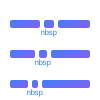
How It Works
This page explains the internal mechanics of Prepositioner and how it processes text.
Technical Overview
Prepositioner uses regular expressions with Unicode support (/u modifier) to identify and replace spaces after prepositions with non-breaking spaces ( ).
Overview
Prepositioner uses regular expressions with Unicode support to identify prepositions in text and replace the space after them with a non-breaking space ( ). The library is designed to handle:
- Plain text - Simple text processing
- HTML content - Preserves HTML structure and attributes
- UTF-8/Unicode - Full support for characters with diacritics
- Case insensitivity - Matches prepositions regardless of case
- Edge cases - Multiple consecutive prepositions, quotation marks, etc.
The Algorithm
Step 1: Pattern Construction
When you create a Prepositioner instance, it builds a regex pattern from the provided prepositions:
<?php

$prepositioner = new Prepositioner(['a', 'v', 'o']);
Internally, each preposition is properly escaped using preg_quote() to ensure special characters are treated literally:
$quotedPrepositions = array_map(fn($p) => preg_quote($p, '/'), $prepositionsArray);
$prepositions = implode('|', $quotedPrepositions); // "a|v|o"
Step 2: Regex Pattern
The main pattern that matches prepositions:
/(\s|^|>|;|quotationMarks)(prepositions)\s+(?=[^>]*(<|$))/iuLet's break it down:
(\s|^|>|;|quotationMarks)- Matches one of:\s- whitespace^- start of string>- closing HTML tag;- semicolon (for HTML entities)- Various quotation marks (
",',„,‚,",',«,‹)
(prepositions)- Matches any of the prepositions\s+- Matches one or more spaces after the preposition(?=[^>]*(<|$))- Lookahead assertion ensuring we're not inside an HTML tag/iuflags:i- Case-insensitive matchingu- Unicode/UTF-8 support
Step 3: Replacement
The matched text is replaced with:
"$1$2 "Where:
$1- The character before the preposition$2- The preposition itself - The non-breaking space
Step 4: Double Application
The pattern is applied twice to handle consecutive prepositions:
$text = $this->safePregReplace($pattern, $replacement, $text);
$text = $this->safePregReplace($pattern, $replacement, $text); // Applied again
This ensures that patterns like "a o text" correctly become "a o text".
Step 5: Escape Markers
Finally, escape markers are removed:
$escapePattern = "/{$quotedEscapeString}({$prepositions}){$quotedEscapeString}/iu";
$text = $this->safePregReplace($escapePattern, "$1", $text);
HTML Processing
Why HTML is Special
When processing HTML content, we must ensure that:
- Prepositions inside HTML tags are not replaced
- Prepositions in HTML attributes are not replaced
- Only prepositions in actual text content are replaced
The Lookahead Solution
The lookahead assertion (?=[^>]*(<|$)) ensures we only match prepositions that are:
- Followed by characters that are NOT
>(not inside a tag) - Until we reach either
<(start of next tag) or end of string
Example:
<a href="/path/v/url">Text v článku</a>- The
vin/path/v/urlis followed by/url">, which contains>, so it's not matched - The
vin "Text v článku" is followed by " článku", which doesn't contain>until the closing tag, so it's matched
Unicode Support
The /u Modifier
All regex patterns use the /u modifier, which enables Unicode support. This allows the library to correctly handle:
- Prepositions with diacritics:
č,ř,ž,ă,ț, etc. - Capital letters outside ASCII:
Č,Ř,În, etc. - Proper case-insensitive matching: Works correctly with Unicode characters
Example:
$prepositioner = Factory::build('slovak');
$text = "Či ide v Bratislave?";
// "či" with diacritic is correctly matched as a preposition
// Output: "Či ide v Bratislave?"
Before Version 4.0
Legacy Behavior
In versions before 4.0, the library did not use the /u modifier. This meant:
- Prepositions with diacritics outside ASCII didn't work correctly
- Case-insensitive matching was ASCII-only
Version 4.0 added proper Unicode support to fix these issues.
Error Handling
Safe Regex Execution
The safePregReplace() method wraps all preg_replace() calls and checks for errors:
private function safePregReplace(string $pattern, string $replacement, string $subject): string
{
    $result = preg_replace($pattern, $replacement, $subject);

    if ($result === null) {
        $error = preg_last_error();
        $errorMessage = $this->getPregErrorMessage($error);
        throw new PrepositionerException("preg_replace failed: {$errorMessage}");
    }

    return $result;
}
Possible errors include:
PREG_BACKTRACK_LIMIT_ERROR- Pattern too complexPREG_RECURSION_LIMIT_ERROR- Pattern recursion limit reachedPREG_BAD_UTF8_ERROR- Invalid UTF-8 in inputPREG_JIT_STACKLIMIT_ERROR- JIT stack exhausted
In version 3.x and earlier, errors were silently ignored and the original text was returned. Version 4.0 throws explicit exceptions for better error handling.
Best Practice
Always wrap formatText() calls in try-catch blocks when processing user input or untrusted content.
Escaping Mechanism
How Escaping Works
You can prevent specific prepositions from being replaced by wrapping them with escape markers:
$prepositioner = new Prepositioner(['a'], '#####');
$text = "Replace a here but not #####a##### here.";
$result = $prepositioner->formatText($text);
// Output: "Replace a here but not a here."
The process:
- During replacement: Escaped prepositions are protected by their markers and not matched by the main pattern
- After replacement: The escape markers are removed, leaving the preposition with a normal space
This is useful when you have abbreviations or other cases where a preposition-like word should not be treated as a preposition.
Quotation Marks
The library respects quotation marks and correctly handles prepositions at the start of quoted text:
$prepositioner = Factory::build('slovak');
$text = 'Povedal: "V meste je pekne."';
// Output: 'Povedal: "V meste je pekne."'
Supported quotation marks:
"- Straight double quote'- Straight single quote„- German/Czech opening quote (U+201E)‚- Single low quote (U+201A)"- Left double quote (U+201C)'- Left single quote (U+2018)«- Left double angle quote‹- Left single angle quote
Performance Considerations
Regex Compilation
The regex pattern is constructed once when the Prepositioner instance is created, not on every formatText() call.
Multiple Passes
The pattern is applied twice to handle consecutive prepositions. For most texts, this is fast enough. For very large texts (100k+ characters), consider:
- Processing in chunks
- Caching results
- Using escape markers to skip sections that don't need processing
HTML Complexity
The lookahead assertion adds some overhead when processing HTML. For plain text, consider using a prepositioner with simpler patterns if you need maximum performance.